
Last November, British actor and “Hamilton” musical star, Giles Terera, claimed in a viral tweet that he and a group of eight other black actors were refused entry at a London pub after being “racially profiled.” However, the blues bar immediately refuted the allegations of racism in a Facebook post, saying that some members of Terera’s group did not have IDs. Now, it appears that the “Ain’t Nothin’ But Blues” bar in central London may be taking legal action against Mr. Terera.
On Nov. 29, 2019, Mr. Terera claimed in a series of tweets that his group of black actors was denied entry while a separate group of white people was allowed into the bar. He tagged the bar and the Evening Standard newspaper.
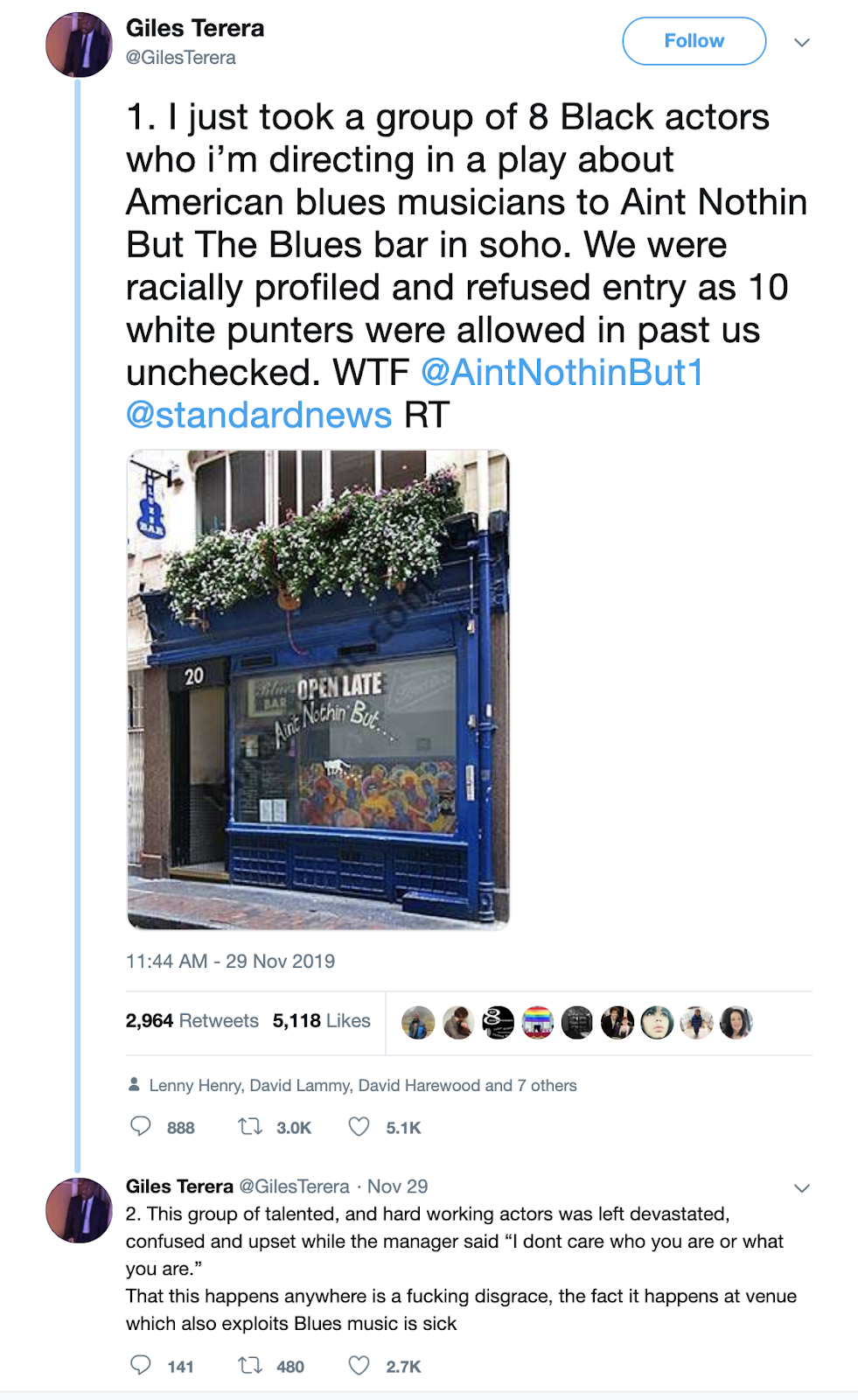
“This group of talented, and hard working actors was left devastated, confused and upset,” Mr. Terera wrote. “That this happens anywhere is a f*cking disgrace, the fact it happens at venue which also exploits Blues music is sick.” He received an outpouring of support from politicians, celebrities and actors. The story was covered in the British press.
However, Mr. Terera’s later deleted his tweets without offering an update or clarification.
Kevin Hillier, owner of “Ain’t Nothin’ But” blues bar, declined to comment on the developments on the incident, stating that the matter was “with our lawyers.”
In a strongly-worded statement posted on the business’ Facebook on Nov. 30, the bar said Mr. Terera’s group could not legally be served because they failed to prove their age with proper identification. “It is a shame they then have to try and use the ‘race’ card to intimidate the staff,” the statement reads. “We now have an unfair reputation which we cannot properly respond to. We have regular customers, and staff, who are black. It makes no difference to us what colour people are.”
Mr. Terera, who starred as Aaron Burr in the London production of “Hamilton,” did not respond to The Post Millennial’s request for comment. In an interview with the BBC in May 2019, he expressed sentiments that being an actor of colour was difficult, as was being a person of colour in Britain.
Want to help us grow? Here's what you can do!

American poet mobbed yet again by woke cultists
The poetry world is full of “typical social justice weaponized academia bullshit” according to poet Joseph Massey, who for sure has reason to know. His work has been published and deleted for a third time since his poetry world mobbing, this time by The Modernist Review.
A few years ago, he was accused of being a shitty boyfriend, extra drunk, and making people uncomfortable at poetry readings. He admitted it. He apologized. He wrote about the experience in Quillette. For this, he has been basically banished by the society of poets. Apologies are seen as evidence of guilt; forgiveness doesn’t exist.
Every time he is published, which happens not infrequently due to the legit merit of his work in the eyes of those publishers, the mob reaches out to those magazines and tells them to pull his work, or else. The Modernist Review caved to this mob, a group that Massey says only consists of about a dozen poets.
Massey submitted poems to The Modernist Review back in August 2019, when a call went out looking for work related to the environment. He sent in a sequence of poems grounded in the natural world, inspired by time spent with family in rural Delaware. In January 2020, he received word from The Modernist Review that they wanted to publish the work in their upcoming issue.
Editor Cecile Varry wrote “If ‘Backroad Scroll’ is still available, we would love to publish it in this month’s issue of the Review, which should be released next week. We really liked it and think that it fits very well with our plan for the issue!” After some logistical back and forth about graphics, the poems were published on The Modernist Review on January 31. Varry tweeted them out with the message “Wonderful poems by @jmasseypoet.” Massey shared that post.
A few hours later, he noticed that his tweet of her post about the poems showed that Varry’s tweet had been deleted. This is when Massey realized the mob had come for him yet again. He went to the site and saw that The Modernist Review had deleted his work. He contacted Varry, asking “Has my work been removed from the issue? If so I’d appreciate an explanation.”
They have not responded. Massey doesn’t think anyone will ever get back to him. The Post Millennial reached out to Varry for comment, but at the time of writing she has not responded.
This is the third time this has happened since his mobbing. The Academy of American Poets did this too, and Virga Magazine. Neither of these outlets offered an explanation. They are afraid of the mob.
Speaking to The Post Millennial, Massey said that “social justice indoctrination is what makes editors terrified. As soon as they get an email or a tweet saying you published an abuser they just want to wipe their hands of it immediately.” They don’t bother to look into it, or ask Massey, or dig any further. Instead, these poetry magazines do what the spineless internet vigilantes tell them to. “They’ve been able to weaponize this new political regime,” Massey said.
And it’s not just contemporary poets who need to toe the line. “There are poets who are professors who are embedded in academia who are openly banning poets from being read,” Massey said, “eradicating them from the canon.” For his part, he is “against erasure, trying to wipe out Walt Whitman because in the 19th century he may have said something unpalatable to the 20th century.”
“In all likelihood, I’m not going to humiliate myself by submitting poems to open calls,” Massey said when asked about his next steps. “So I need to find alternative means of disseminating my work.” He’s actively working towards that goal.
This is a great time for writers and artists to step out of the framework of the established publishing houses, magazines, and arts cultures, and make their own. If the going outlets, the arbiters of arts culture, can’t handle their responsibility to maintain and uphold free speech, to decry unfounded allegations, or at the very least to offer forgiveness when an artist screws up, they deserve to lose their relevancy and their impact.
Want to help us grow? Here's what you can do!

Anti-feminist blogger ordered to stay clear of UQAM campuses
A resident of the Hochelaga-Maisonneuve neighbourhood in Montreal has been ordered to keep away from the UQAM campuses while his criminal case is pending. Jean-Claude Rochefort, 71, is an anti-feminist blogger who was charged back in December with inciting hatred towards women according to the Montreal Gazette.
Rochefort was arrested in Montreal by police in December after a professor at UQAM filed a complaint against Rochefort allegedly posted a blog about Marc Lepine, the man behind the infamous Ecole Polytechnique mass shooting in 1989. It was a shooting that killed 14 women and injured 14 more. Just prior to the 30th anniversary of the shooting, Rochefort praised Lepine in a blog most and was consequently arrested.
Quebec Court Judge Alexandre Dalmau was informed that Rochefort wrote most of his blogs in English even though his native tongue is French on Friday. During his bail hearing in December, Rochefort was described by a prosecutor as having written some of the worst examples of inciting hatred. Rochefort was granted bail on Dec. 16 after agreeing to make a $200 deposit and post $2,000 bond. Along with conditions that required Rochefort to cancel any and all internet service providers.
Prosecutor Josian Laplante told reporters on Friday that she requested an additional condition, on behalf of the university that he not be permitted to enter on the campuses of UQAM given some of the references he made in his blog although there is no evidence that he had gone to the campuses any time recently.
“You have to understand that in the articles that were published there were references to a UQAM employee and the university asked that the employee be protected in some way. That is why the Crown and the defence consented to it,” Laplante said.
The case is scheduled to return to court on Feb. 21. Whether or not it will go to a trial will be determined after Laplante and Rochefort’s lawyer meet to discuss the possibility of a settlement. Rochefort has not denied that he was the one who wrote the blogs that led to his arrest. His charge is the wilful promotion of hatred of an identifiable group, between Sept. 1 and Dec. 5 2019, “by communicating statements, other than in private conversation.”
Rochefort was arrested back in 2009 just before the 20th anniversary of the Polytechnique shooting as well. Rochefort was arrested for uttering threats towards women through the use of his website in addition to posting a photo of an armed Lepine. The charge would eventually be dropped in 2010 however months later Rochefort plead guilty to possession of an unauthorized firearm. He was sentenced to two years of probation and 50 hours of community service.
Want to help us grow? Here's what you can do!

CTV parts ways with journalist after coronavirus joke
On January 26, CTV investigative journalist Peter Akman tweeted a photo of himself standing in front of an Asian man wearing a mask with the caption “Hopefully ALL I got today was a haircut.”
The now-deleted tweet was poorly received, quickly amassing dozens of accusations of anti-Chinese racism and insensitivity in the face of what has just been declared a global health emergency by the World Health Organization.
Akman quickly apologized, responding to the backlash with a repeated copy-and-paste of his explanation of the situation. The man in the photo was apparently a barber in Akman’s city of Toronto and had been offering masks to patrons. My tweet earlier today was insensitive.
My barber told me he was offering everyone masks.
I apologize for any offence I may have caused.
The statement was equally condemned by Twitter users, with many accusing Akman of refusing to acknowledge the racism behind his initial tweet:
It wasnt insensitive. It was straight up racist.— meg fenway (@megfenway) January 26, 2020
Today, a source speaking to The Post Millennial provided information that Peter Akman was no longer working with CTV. The journalist’s profile no longer appears on CTV’s W5 Team Bios page, where it did just two days ago, according to the Internet Archive. His CTV profile has also been removed from the website.
Peter Akman had been an investigative journalist with CTV since 2013 after leaving CBC in 2006, and had gained some notoriety for reporting live from international sites such as Afghanistan, Israel, Kuwait, and Libya.
Want to help us grow? Here's what you can do!

The Washington Post cancelled its number one canceller
Felicia Sonmez has received an outpouring of support from colleagues who were aghast at her suspension from the Washington Post. She was suspended after tweets reflecting mixed emotions over Kobe Bryant’s death, and while the media fusses and fumes over whether or not the suspension was justified, this is a classic case study in contemporary cancel culture. Sonmez took the reins on calling people out for alleged misdeeds, and now she’s being called out for her own.
It goes without saying that Sonmez should not have received death threats on Twitter about her mixed emotions about basketball legend Kobe Bryant’s tragic death. She shouldn’t have had to live in such fear that she retreated from her home to a hotel. All that is unacceptable, but in our age of cancellations and persistent moralistic vitriol, it’s what a person can expect when they befoul the Twitter stream. Sonmez probably should have known all this. She has been vocal about the necessity of removing men and women from their positions without the benefit of due process. This turn of events, where the social media verse turns on her for a couple of tweets wherein she expressed her personal view, should not come as a surprise.
Sonmez is one of the architects of the cancel culture that currently plagues us. She was one of the first accusers of former LA Times foreign correspondent Jonathan Kaiman, sending a letter to the LA Times in which she described him as exhibiting “problematic behaviour.” While they were both heavily intoxicated, by Sonmez’s own admission, she writes: “Even though parts of the evening were consensual, while on the way, Jon escalated things in a way that crossed a line.” She noted that the alcohol made it hard for her to remember, and Kaiman has stated that he remembers it differently. Though he refuted the story, he lost his job, and like Sonmez, he was afforded no due process. You say,”Felicia is a survivor of assault who bravely came forward with her story 2 years ago.”How do you explain glaring inconsistencies in Felicia’s story shown here: https://t.co/NcN6zfmdU4 When Atlantic reporters criticized Felicia,she tried to get them fired. Your thoughts? https://t.co/W4dJBgaIVR
Sonmez is also the person behind two mobbings of women writers. She tried to get Caitlin Flanagan and Emily Yoffe fired from their positions (at The Atlantic and Reason respectively) for the high crime of criticizing her.

Brett Kavanaugh was shamed by Sonmez for his lighthearted speech to The Federalist Society in 2014, which she published along with excoriations against him and his college behaviours. She called him out for comments such as “Always act as if your actions are public,” and “You will make mistakes. Sometimes big ones. Admit it, resolve not to do it again, and make sure you don’t do it again.” Apparently that’s no good when you’re going to end up in confirmation hearings before the Senate and a woman who you don’t even remember ever meeting accuses you of raping her at a party you’re pretty sure you didn’t attend. In April 2014 speech to the Yale Law School Federalist Society banquet, Kavanaugh reminisced about partying (‘what happens on the bus stays on the bus’) & related a story about a friend drunkenly falling, breaking a table & being given more beers by a professor. pic.twitter.com/MhzBxqtLgn— Felicia Sonmez (@feliciasonmez) September 17, 2018
Now it’s Sonmez’s job on the chopping block. Maybe she’s looking for a way to apologize and keep her career intact, or maybe she’s going to double down. Neither, as we have seen, is likely to lead to success. There’s no due process for stupid tweets, and we know from years of this nonsense that apologies only lead to further public abrasions. Probably, she won’t lose her friends, so that’s lucky. Lots of her friends and colleagues don’t understand what the big deal is, or why so many in the media are out for her job. Hundreds of her colleagues have signed a letter to Marty Baron and Tracy Grant stating that they don’t think it’s fair that she should have been suspended. The Washington Post’s union has condemned the actions of management.
What they don’t seem to understand is that the plight of Felicia Sonmez is an object and abject lesson about cancel culture. She has done this to others. She has called for the suspension of due process and the termination, of her own peers. Her voice has loudly denounced those who have been hit with allegations without evidence. Sonmez has helped us get used to the idea that accusations are enough to take you down. It’s a commonplace idea, now, thanks to her and her peers in thought crime. Once we are so long immersed in the sludge of it, turnabout seems like fair play.
It isn’t, of course. Everyone deserves a second chance (or a proper first chance)—an opportunity to clear their name, to shake off wrongful incriminations and proceed with life and livelihood. It’s better when we do away with game theory and start treating each other like human beings. After all, life is not a game and the people we love are not players. Sonmez foolishly thought she would always thrive in a world without due process. She thought that due process was irrelevant when we could all discern the truth based on platitudes and hashtag callouts. But her situation is illustrative of the truth that no one survives in such a world. That’s the nature of this beast. The accuser will always become the accused.
Don’t believe us? Just wait.


Social Media